
Bias/Variance Tradeoff
Contents
Bias/Variance Tradeoff#
Bias#
Error between average model prediction and ground truth
The bias of the estimated function tells us the capacity of the underlying model to predict the values
\(bias = \mathbb{E}[f'(x)] - f(x)\)
Variance#
Average variability in the model prediction for the given dataset
The variance of the estimated function tells you how much the function can adjust to the change in the dataset
\(variance = \mathbb{E}[(f'(x) - \mathbb{E}[f'(x)])^2]\)
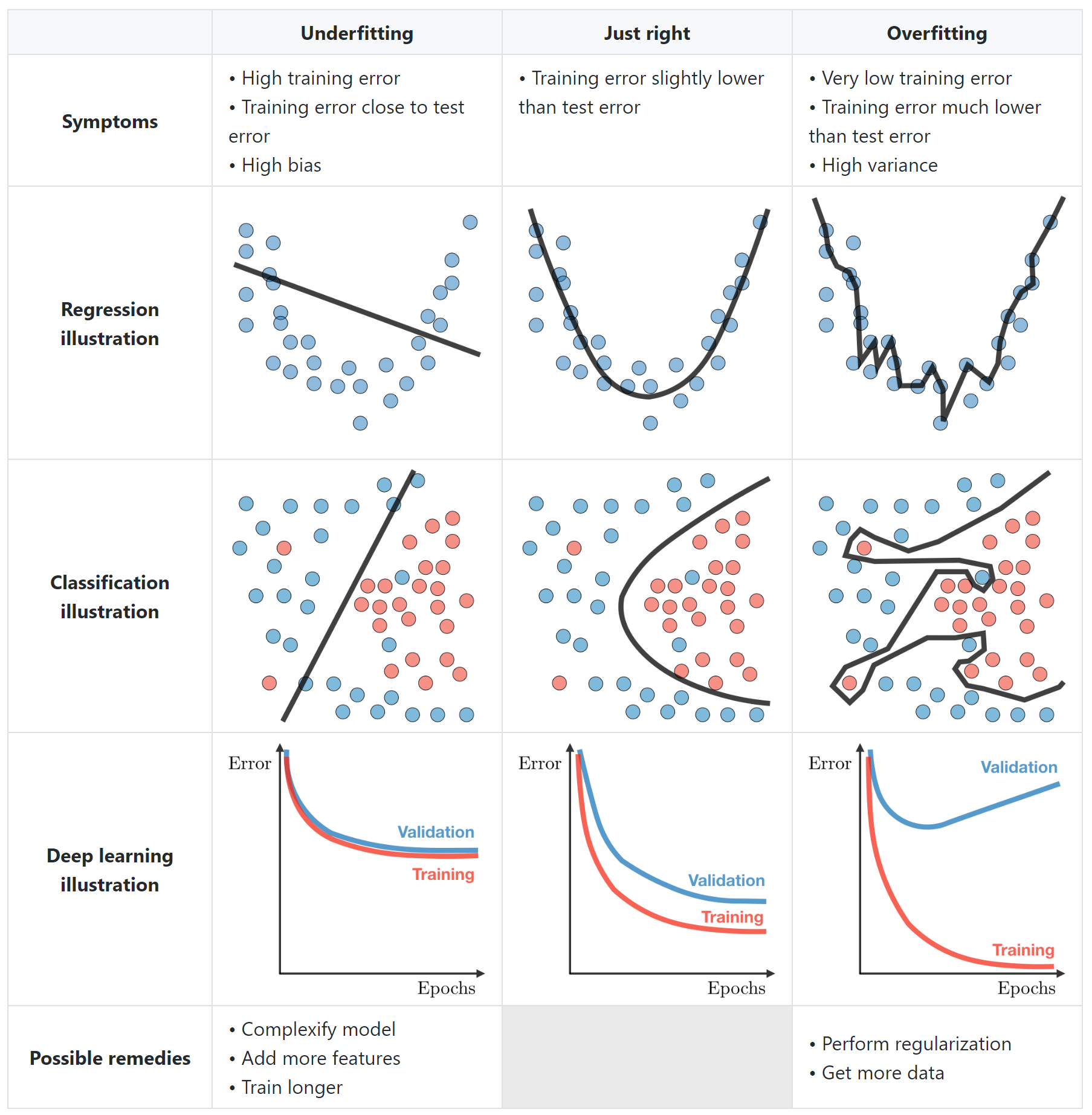
High Bias:
Overly-simplified Model
Under-fitting
High error on both test and train data
High Variance:
Overly-complex Model
Over-fitting
Low error on train data and high on test
Starts modelling the noise in the input
Bias variance Trade-off
Increasing bias (not always) reduces variance and vice-versa
The best model is where the error is reduced.
Compromise between bias and variance while choosing the best model